

Following the release of the 2026 CSI Indaba Outcome Report, the harder work begins: turning recommendations into practice. The conversations are documented and the challenges named. We must now show how those outcomes can shape decisions made by companies, funders and development partners. At CSI Indaba, Africa’s Biggest CSI Classroom, the inequality mandate asked how corporate social investment could change the conditions that exclude people from opportunity. We introduce the Responsible Business Scorecard as our first practical development milestone towards that ambition.
Our broader objective is to help move South Africa beyond extreme inequality towards more equitable access to opportunity, resources and security. This requires understanding which barriers funding addresses, whose opportunities it expands and whether progress lasts. The Outcome Report recommends a board-level inequality and inclusion scorecard alongside capital and portfolio mapping. Developed by Simphiwe Mtetwa, our initial framework focuses on eligible CSI funding and its destinations. It contributes to a wider agenda encompassing employment, ownership, wages and institutional change.
The report’s summary of Professor Nicholas Ngepah’s contribution identifies five binding areas: human capability; labour-market exclusion and skills mismatch; spatial exclusion; capital ownership and market concentration; and weak institutional and governance capacity. These provide the diagnostic foundation for our framework. Professor Steven Friedman’s contribution highlights inherited institutional practices and the divide between organised insiders and excluded outsiders. His analysis reinforces the importance of community participation. These contributions inform our thinking without implying either professor’s endorsement of the proposed scoring rules.
Imagine a young girl receiving a bursary. Her tuition is covered, yet food is scarce, electricity unreliable and transport expensive. Even after graduation, employment may remain inaccessible. The bursary matters. Its potential depends partly on conditions beyond the classroom.
Our four rungs organise funding around those connected conditions: survival, stability, self-reliance, and security. Companies may enter at different rungs while understanding how their contributions connect.

Figure 1 — Four connected funding purposes: survival 15%, stability 25%, self-reliance 30% and security 30%.
Survival receives 15% to retain essential relief, including food and emergency assistance. Stability receives 25% because dependable water, healthcare, electricity and transport make participation possible. These investments support human capability and address barriers associated with location and institutional weakness.
Self-reliance receives 30% to emphasise education connected to progression, employment pathways, enterprise and access to markets. Security receives 30% to protect gains through safer environments, secure tenure, resilience and dependable institutions. Together, they direct 60% of the proposed emphasis towards enabling livelihoods and sustaining progress.
These weights express strategic priorities informed by the binding constraints. They are not mathematically derived from them or scientifically established shares of impact. Testing must establish whether this balance supports meaningful progress against inequality. Within each rung, the proposed geographic reference allocation is 50% rural, 30% peri-urban and 20% urban. The twelve cells make investment destinations visible. Standard points are capped within each cell, adding to the rung’s maximum.
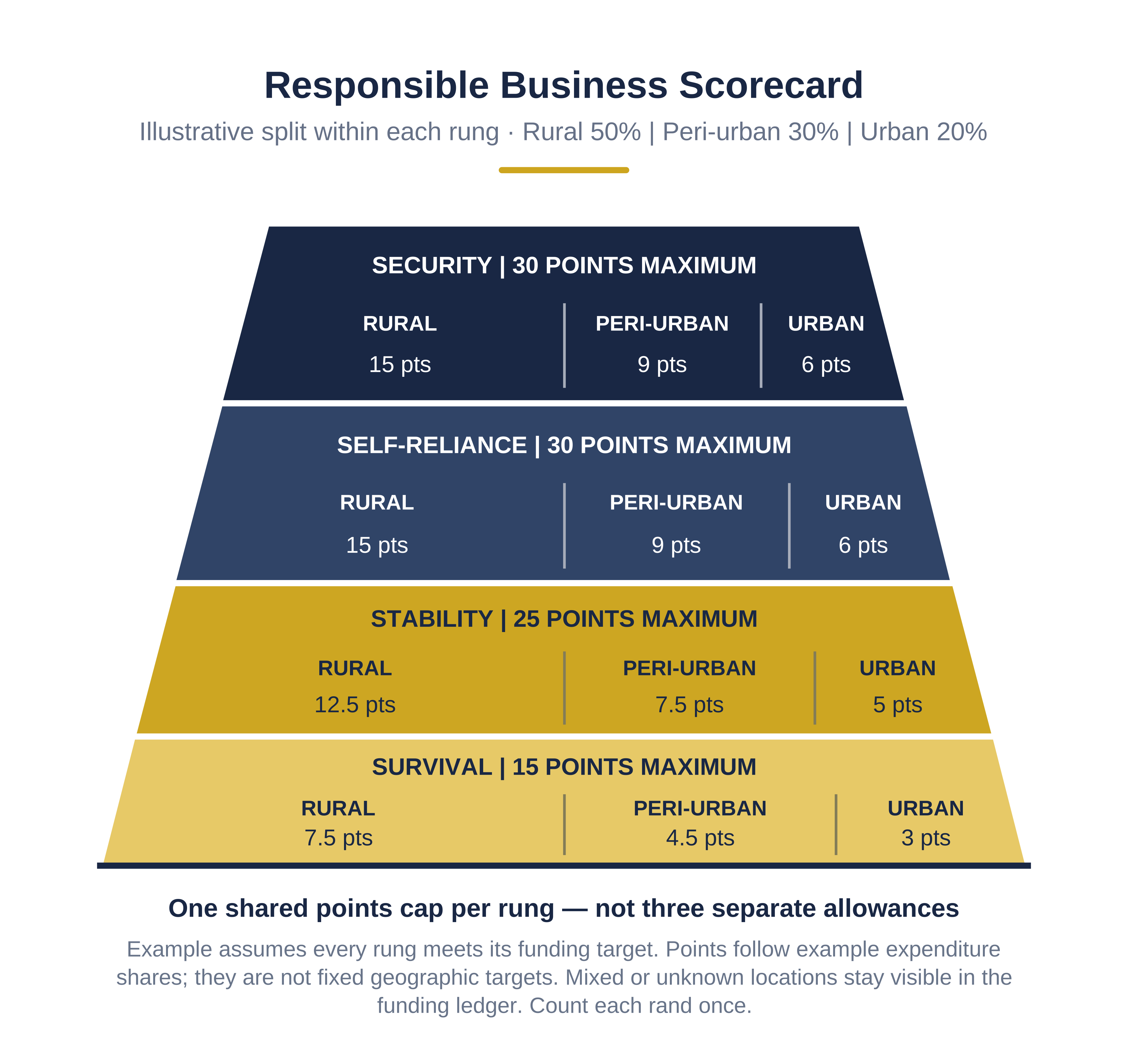
Figure 2—Twelve geographic funding cells, with individual caps within the four rung totals
Additional rural investment can now earn rural top-up points to fill the remaining points within the same rung. Top-ups contribute to the final score and Responsible Business Level, while the overall maximum remains 100. Consider survival within a R10 million eligible cash portfolio. Its R1.5 million reference allocation comprises R750,000 rural, R450,000 peri-urban and R300,000 urban. Suppose actual spending is R1 million, R200,000 and R300,000 respectively. Standard points total 12.5 out of 15.
The additional R250,000 of rural spending earns 2.5 top-up points, bringing survival to its full 15. Additional peri-urban or urban spending receives no equivalent treatment. This deliberately permits a rural-focused route to full alignment. Rural top-ups cannot fill gaps in another rung. Reports must still disclose geographic shortfalls, even when the rung achieves full points. Rural location alone does not prove deprivation or impact. Responsible Business Levels use the final capped score: Level 1 at 90–100; Level 2 at 80–below 90; Level 3 at 70–below 80; Level 4 at 50–below 70; and Level 5 below 50. Level 3 remains the proposed acceptable benchmark.
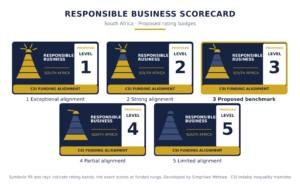
Figure 3 — Proposed Responsible Business Level badges, marked proposed during testing.
Only eligible cash programme expenditure enters the calculation. Cash purchases for beneficiaries can qualify. Donated stock and volunteer time are disclosed separately without funding points. Unclassified eligible cash remains in the denominator until its allocation is evidenced. The companion Investable NGO Scorecard will assess delivery partners’ readiness and programme evidence. Corporate points follow qualifying expenditure, rather than an NGO’s badge. Our sample reporting spreadsheet illustrates allocations, constraints, evidence, outcomes and follow-up actions.
A Responsible Business Level measures funding alignment. Evidence over time must establish whether barriers are reduced. That distinction keeps our ambition accountable: more deliberate investment and reporting, guided by communities and directed towards dismantling the conditions that sustain inequality.

Leave a Reply